
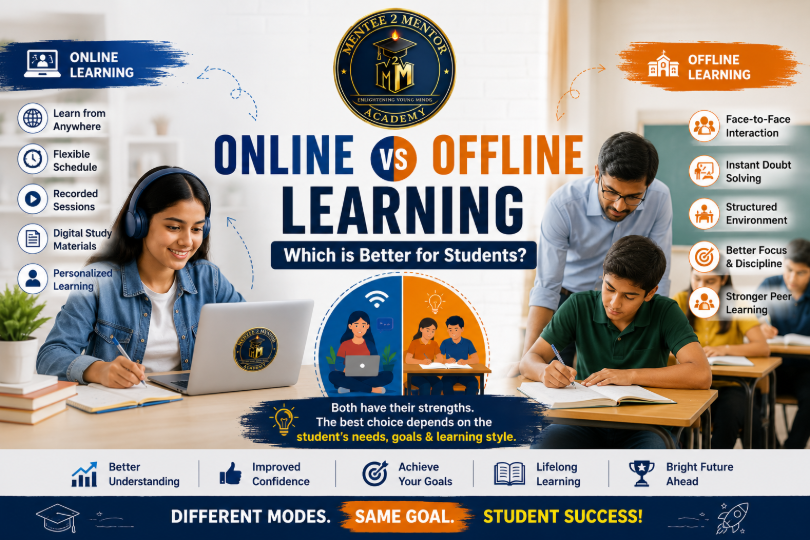
Published by Mentee2Mentor Academy | Education | Learning Insights
Introduction: The Question Every Parent Is Asking
Contents
- 1 Introduction: The Question Every Parent Is Asking
- 2 What Do We Mean by Online vs Offline Learning?
- 3 The Case for Online Learning
- 4 The Case for Offline Learning
- 5 What the Research Says
- 6 The Hybrid Answer: Why a Platform Like Mentee2Mentor Changes the Debate
- 7 Online vs Offline Learning: A Side-by-Side Comparison
- 8 Which is Right for Your Child?
- 9 How Mentee2Mentor Bridges the Gap
- 10 Conclusion: Beyond the Debate, Toward the Best Outcome
Walk into any school gate in Faridabad, any parents’ group on WhatsApp, or any teacher’s staffroom — and you will find the same debate happening. Online vs offline learning: which one actually works better for students?
If you are a parent searching for the best tuition in faridabad, this question matters deeply to you. It affects where you spend your money, how your child spends their evenings, and ultimately, how well they perform in their exams and beyond. And the honest answer is: there is no one-size-fits-all verdict. Both models have real strengths. Both have genuine limitations. And the smartest families are learning how to look past the debate and find the approach that actually fits their child’s needs.
In this blog, we are going to break down online vs offline learning with complete honesty — exploring the advantages and disadvantages of each, looking at what the research says, and helping you make an informed decision for your child’s education.
What Do We Mean by Online vs Offline Learning?
Before comparing the two, it helps to define them clearly.
Online learning refers to education delivered through digital platforms — live classes conducted over the internet, recorded video lessons, digital tests, study material shared electronically, and real-time communication between teachers, students, and parents through a single platform. Think of platforms like Mentee2Mentor Academy, which allows teachers to conduct live classes, share study material, and take online tests all in one place.
Offline learning refers to the traditional model — students physically attending classes at a coaching centre, tuition teacher’s home, or school. The teacher is present in the room, the student is present in the room, and learning happens face to face.
Both are forms of education. Both can be done well or poorly. The question is which one serves your child’s specific needs, learning style, and lifestyle better.
The Case for Online Learning
1. Flexibility That Fits Real Life
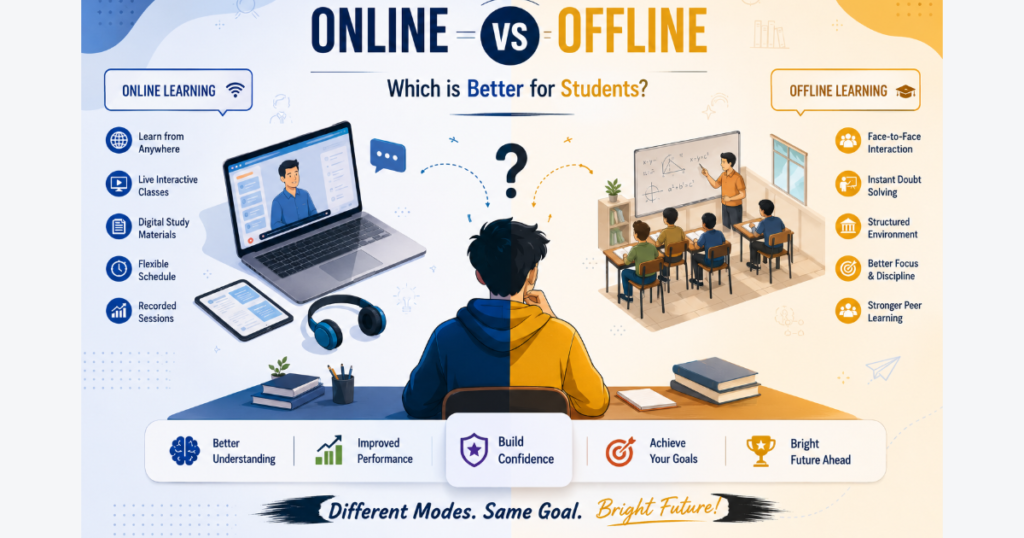
One of the most powerful advantages of online vs offline learning is the flexibility that digital platforms offer. Students are not locked into a fixed batch time that may clash with school sports, family commitments, hobby classes, or simply the need for a break.
With online learning, students can attend live sessions at scheduled times that fit their day, and access recorded lessons whenever suits them. This flexibility is not laziness — it is smart time management. When learning fits naturally into a student’s schedule, they show up more alert, more engaged, and more willing to participate.
For families in Faridabad dealing with traffic, long school hours, and packed evenings, this flexibility is not just convenient — it is genuinely valuable.
2. No Time Lost to Travel
In a city like Faridabad, getting from home to a coaching centre and back can easily eat up an hour or more every day. That is five to six hours every week — time that could be spent studying, sleeping, playing, or simply recovering from a long school day.
Online learning eliminates commute time entirely. Students sit down at their desk and the class begins. This is one of the clearest, most measurable advantages in the online vs offline learning debate, and it is one that families consistently underestimate until they experience the difference.
3. Access to Better Teachers
In offline learning, your child is limited to the teachers who are physically available in your area. If the best Physics teacher in Faridabad lives across town and does not travel to your neighbourhood, your child simply does not get access to them.
Online learning removes this geography barrier entirely. A student in any part of Faridabad — or anywhere in India — can learn from the most qualified, most engaging teacher on a platform. This democratisation of teaching talent is one of the most transformative aspects of online education, and it consistently tips the online vs offline learning balance toward digital platforms.
4. Data-Driven Progress Tracking
Online platforms like Mentee2Mentor offer something offline tuition simply cannot: real-time, data-backed insights into a student’s performance.
When a student takes a test on an online platform, they receive instant results, chapter-wise performance breakdowns, time-per-question analytics, and historical progress graphs. Parents can view this data at any time without waiting for a parent-teacher meeting at the end of term.
This level of insight transforms the learning process from a guessing game into a precise, targeted exercise. Teachers can identify exactly where a student is struggling and adjust their teaching accordingly. Parents can spot issues early and intervene before small gaps become large ones.
5. Rich Digital Study Resources
Online learning environments are naturally resource-rich. Teachers can upload notes, PDFs, practice papers, video explanations, formula sheets, and revision guides — all organised by chapter and accessible to students at any time from any device.
Students who want to revise a concept at 10 PM the night before an exam can do so without calling anyone or searching through notebooks. Everything is right there. This accessibility changes how students study, making revision more efficient and self-directed.
6. Parent Involvement Without Intrusion
One of the underappreciated strengths of online learning platforms is how they enable parent involvement. On a platform like Mentee2Mentor, parents can track attendance, review test scores, and communicate directly with teachers — all without sitting in on every class or hovering over their child.
This balance between involvement and independence is something offline tuition struggles to achieve. Either parents are completely out of the loop, or they have to physically attend sessions to stay informed. Online platforms solve this elegantly.
The Case for Offline Learning
1. Human Connection and Physical Presence
There is something irreplaceable about being in the same physical space as a teacher. Body language, eye contact, the energy of a focused classroom — these elements contribute to learning in ways that are difficult to replicate on a screen.
For some students, especially younger children or those who struggle with self-discipline, the physical presence of a teacher is a powerful motivator. They sit up straighter, pay closer attention, and are less likely to get distracted when someone they respect is in the room with them.
In the online vs offline learning debate, this human element is the strongest card that offline education holds.
2. Structured Environment for Distraction-Prone Students
Home is full of distractions. Younger siblings, television, mobile phones, the temptation to lie on the bed — all of these compete with a student’s attention during online classes. For students who have not yet developed strong self-discipline, the offline classroom provides a structured environment that makes focus easier.
When a student walks into a coaching centre, the physical act of being in a learning space signals to the brain that it is time to focus. This environmental cue is powerful, and it is something online learning must work harder to replicate.
3. Immediate, In-Person Doubt Clearing
When a student raises their hand in an offline class and a teacher walks over to explain something directly, pointing at the student’s notebook, writing on the board, adjusting their approach based on the student’s expression — that is a uniquely effective form of teaching.
In-person doubt clearing has a tactile, immediate quality that video communication can sometimes lack. For complex subjects like Mathematics or Physics, where a student’s confusion often needs to be seen and diagnosed before it can be resolved, this in-person dynamic can make a real difference.
4. Social Learning and Peer Motivation
Learning alongside peers in a physical space creates a form of motivation that is hard to replicate online. When a student sees their classmates working hard, asking good questions, and competing healthily for marks, it inspires similar effort.
Study groups that form naturally in offline coaching centres, the friendly rivalry over test scores, the shared experience of preparing for the same exam — these social elements contribute to academic performance in ways that research consistently supports.
What the Research Says
Studies on online vs offline learning have produced nuanced findings. There is no universal winner.
Research consistently shows that online learning can be equally effective — or more effective — than offline learning when:
- The student is self-motivated and disciplined
- The platform offers genuine interactivity, not just passive video watching
- Regular assessments and feedback loops are built into the learning process
- Parents and teachers stay engaged and involved
Offline learning tends to outperform online learning when:
- Students are younger and need more external structure
- The student lacks access to a quiet, distraction-free study space at home
- The teacher-student relationship requires significant in-person emotional support
The conclusion that most education researchers reach is not that one model is superior — it is that the most effective learning environments combine the strengths of both.
The Hybrid Answer: Why a Platform Like Mentee2Mentor Changes the Debate
Here is what most online vs offline learning comparisons miss: the best answer is not a choice between the two. It is a thoughtfully designed platform that captures the strengths of both.
Mentee2Mentor Academy is exactly that platform.
On Mentee2Mentor, teachers conduct live classes — not pre-recorded lectures, but real-time, interactive sessions where students ask questions, teachers respond, and learning happens in the moment. This preserves the dynamic, human quality of offline teaching while delivering it through a flexible, accessible digital format.
At the same time, Mentee2Mentor’s online infrastructure provides everything that offline tuition cannot: instant test results, performance analytics, organised digital study material, parent dashboards, and access to qualified teachers regardless of geography.
For students and families in Faridabad looking for a learning solution that is rigorous without being rigid, structured without being inflexible, and personal without requiring a physical commute — Mentee2Mentor is the answer to the online vs offline learning debate.
Online vs Offline Learning: A Side-by-Side Comparison
| Factor | Online Learning | Offline Learning |
|---|---|---|
| Flexibility | High — choose your schedule | Low — fixed batch timings |
| Access to teachers | Unlimited — geography no barrier | Limited to local availability |
| Travel time | None | Significant in cities |
| Parent visibility | Real-time dashboards | Limited, end-of-term meetings |
| Study material | Digital, organised, always accessible | Physical notes, often incomplete |
| Performance tracking | Data-driven, instant analytics | Manual, periodic |
| Human connection | Strong on interactive platforms | Strongest in person |
| Environment for focus | Requires self-discipline | Built-in structure |
| Social learning | Limited | Natural and organic |
| Cost | Often lower (no infrastructure) | Often higher (rent, utilities) |
Which is Right for Your Child?
Here is a simple framework for making this decision:
Choose online learning if:
- Your child is self-motivated and reasonably disciplined
- Your family values flexibility and time efficiency
- You want real-time visibility into your child’s academic progress
- Access to the best available teacher — regardless of location — matters to you
- Your child learns well when given organised digital resources
Choose offline learning if:
- Your child is young and needs significant external structure
- The social environment of a classroom is a major motivator for them
- Your home environment makes focused online learning difficult
- Your child particularly benefits from in-person emotional connection with a teacher
Consider a hybrid approach if:
- Your child needs structure but also benefits from flexibility
- You want the best of both worlds — live teaching and digital tools
- A platform like Mentee2Mentor, which combines live instruction with digital infrastructure, fits your expectations
How Mentee2Mentor Bridges the Gap
Mentee2Mentor Academy was built with a deep understanding of the online vs offline learning debate — and a clear intention to resolve it, not add to it.
Every feature on the platform is designed to deliver the warmth, rigour, and effectiveness of offline teaching through the convenience, intelligence, and accessibility of a digital environment.
Teachers on Mentee2Mentor are not reading from scripts or uploading pre-recorded videos. They are teaching live, engaging with students, adapting to their questions, and building real relationships across the screen. Students are not passive viewers — they are active participants in their own education.
And parents are not left wondering. They are informed, involved, and confident that their investment in their child’s education is producing measurable results.
This is what makes Mentee2Mentor the right answer to the online vs offline learning question for thousands of students and families across Faridabad and beyond.
Conclusion: Beyond the Debate, Toward the Best Outcome
The online vs offline learning debate will continue — and it should, because it reflects a genuine tension in how education works and what students need. But for most families, the goal is not to win the debate. It is to find what works for their child.
The answer, increasingly, is a high-quality online platform that delivers real teaching, real feedback, and real results — with the added benefit of convenience, flexibility, and full parent visibility.
Mentee2Mentor Academy offers all of that. Whether your child needs structured live classes, organised study material, data-driven test feedback, or simply a teacher who knows their name and tracks their progress — Mentee2Mentor delivers it.
The debate between online and offline learning is interesting. Helping your child succeed is what matters. Start today.
Ready to experience the best of both worlds? Visit Mentee2Mentor Academy and book your first live class for free.
Tags: online vs offline learning, best tuition in Faridabad, Mentee2Mentor Academy, online education India, live classes online, CBSE tuition, hybrid learning